

Navigating the minefield that is the NDIS can be a challenging task for many. Drill down to having to undertake a NDIS audit and you may feel as if the wheels are slowly starting to fall off your bike! In this blog, we de-code and break down what is confusing for many. We explore what a NDIS audit involves, and the different pathways providers may need to go down to achieve registration. We also look at how you get through an audit, the costs associated and the post audit timeframe you may face whilst you wait for a registration outcome from the NDIS Commission.
What Does an NDIS Audit Involve?
All care providers that wish to become a registered NDIS Service Provider must undertake a NDIS Audit. These audits involve a review of a provider’s key personnel, staff, and services delivered to ensure participants are in receipt of high-quality, person-centred care and support.
Once a provider submits their application for registration via the NDIS Commission Portal, they will receive a document known as an Initial Scope of Audit (ISoA). The ISoA will indicate whether the provider is required to undertake a ‘Verification’ or ‘Certification’ audit and can be presented to various approved quality auditors (AQAs) to obtain a quote and plan for the audit. Providers have full autonomy over which AQA they choose to engage with for the duration of their audit.
AQAs are required to independently audit providers against the NDIS Practice Standards for certification audits. This may vary in complexity and duration based on a number of factors including but not exclusive to; registration groups being audited, the number of staff and key personnel employed by the provider, the number of sites a provider may have and the location(s) in which they operate.
The NDIS Practice Standards are made up of a core module which includes:
• Rights and responsibilities
• Provider governance and operational management
• The provision of supports and;
• The support provision environment
In addition to the core module, there are several other modules that may require a review at the time of the audit. Each have their own outcomes and indicators that must be demonstrated by providers during the audit. These other modules include:
• Module 1: High intensity daily personal activities
• Module 2: Specialist Behaviour Support
• Module 2a: Implementing behaviour support plans
• Module 3: Early childhood supports
• Module 4: Specialised support coordination
• Module 5: Specialised disability accommodation (SDA) &
• Module 6: Verification
Once an audit has been completed, the goal for any provider is to have the AQA make a recommendation for certification to the NDIS Commission. Provided there are no adverse issues identified by the Commission or other extenuating circumstances, this should result in registration for the provider.
What is the Difference Between NDIS Verification and Certification?
When it comes to undertaking an NDIS Audit, it is important to note that there are two different types of audits. Providers who typically deliver services deemed to be lower risk or lower complexity, are required to complete a ‘verification audit’.
Verification audits are conducted as remote desktop audits by approved quality auditors. Providers must show documentary evidence of their ability to meet outcomes under:
• Human Resource Management
• Incident Management
• Complaints Management and
• Risk Managment
In contrast, providers may be required to undergo a ‘certification audit’ as the supports and services they provide (or intend to provide) have been deemed more complex or higher risk by the NDIS Commission.
Certification audits include a review of the providers documentation (e.g. policies, procedures, business plans etc.), onsite visits, and interviews conducted with NDIS participants in addition to staff.
Providers are assessed on their ability to meet outcomes under the NDIS Practice Standards (including both core modules and any relevant supplementary modules as mentioned above). For providers delivering supports that fall under the registration group High Intensity Daily Personal Activities, they will also be assessed against the High Intensity Supports Skills Descriptors (HISSD).
Providers are not able to choose whether they undertake a verification or certification audit, as this is predetermined by the NDIS Commission. Regardless of which route a provider needs to follow to, it is important to have a solid understanding of the obligations that come with being a registered provider.
How Do I Get Through a NDIS Audit?
Audits generally evoke a sense of fear and nerves for those on the receiving end. However it doesn’t have to be that way. The NDIS Practice Standards clearly define the expectations placed upon a provider and their obligations not only to participants, but to staff as well.
To get through a NDIS audit successfully, there is no secret recipe or hack to follow. As a starting point, providers should consider the questions below when looking at each outcome:
1. Do we have appropriate policies and procedures in place to guide practice?
2. Are we doing what we say we are doing?
3. Is this documented appropriately and easily accessible by the right individuals?
Now this may sound simple, but you’d be surprised as to how many providers either:
a) don’t have adequate policies and procedures in place or;
b) have the necessary policies and procedures in place but cannot demonstrate how these are enacted in everyday operations.
Audits, particularly certification audits, involve interviews with both staff and participants. It is important that they too understand how the service operates, how they can voice their concerns, report incidents and inform the delivery of supports. Providers should also consider the different methods by which they make this possible and ensure that alternative methods of communication are available where required.
How can Hirey help during a NDIS Audit?
Let’s say for example you are undertaking a certification audit against the Core Module and Module 1: High Intensity daily personal supports. As an industry specific platform helping providers source workers faster and cheaper than ever before, Hirey also doubles as an evidence tool.
Having a subscription to Hirey can demonstrate to auditors your commitment to building a steady workforce and be a strategy used to overcome staffing shortfalls which can ultimately impact your continuity of supports. When relating this back to the NDIS Practice Standards, this could be applied specifically to Core Module 2: Provider Governance and Operational Management under sections 10) Risk Management, 15) Human Resource Management and 16) Continuity of Supports.
In addition, the Hirey Search function can demonstrate to auditors your ability to identify specific skills and requirements needed for various programs, in addition to helping your team identify workers that are trained in complex support areas (relevant to Module 1: High Intensity daily personal supports).
How Much Does a NDIS Audit Cost?
The cost of an NDIS worker screening check can vary depending on the state or territory in which the check is conducted. Typically, the fee ranges between $80 to $150. This fee covers the comprehensive assessment process, including the review of criminal history, workplace misconduct, and other relevant factors that contribute to determining a worker’s suitability to engage with NDIS participants.
Remember to keep a copy of your receipt to provide to your accountant/tax professional to assist with any work-related expense claims. Consider it as an investment in your own professional development and compliance. For more information on the costs per state or territory, see below.
How Long Does NDIS Registration Take After Audit?
Due to the volume of applications being processed, there is no specific timeframe set for approval. Once your auditing body has submitted their recommendation to the NDIS Commission, there is not much else that they can do. The decision then rests with the Commission to review the application and make their final decision. In the NDIS Quality and Safeguards Commission Q1 2023-24 Quarterly Performance Report, the Commission did release stats around registration decision timeframes as seen in the image below: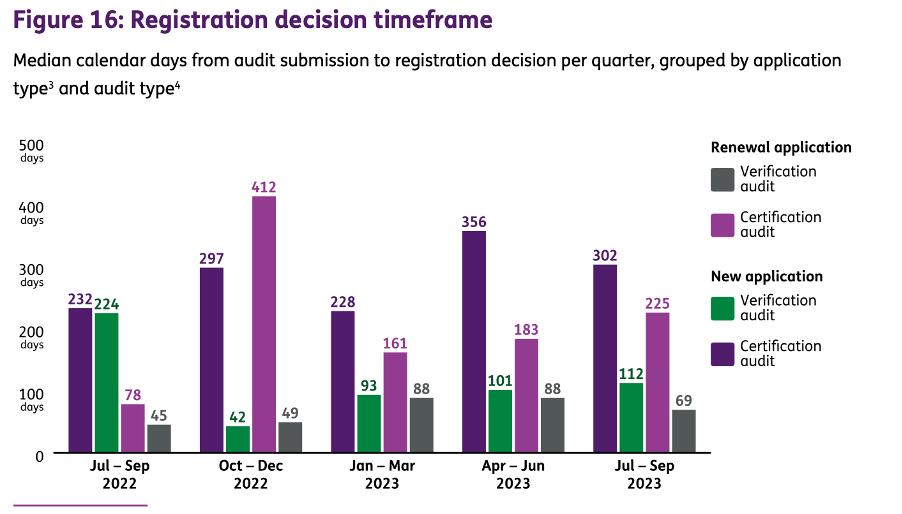
Source: NDIS Quality and Safeguards Commission Q1 2023-24 Quarterly Performance Report
This can provide you with a rough guide as to the expected wait time, however you can always follow up on your application directly with the Commission.
Undertaking a NDIS Audit soon? Be sure to include Hirey in your evidence!
Although the thought of undergoing a NDIS Audit can be daunting, it can be quite a useful and insightful activity if approached in the right manner. Providers will benefit from having a good understanding of the standards they will be audited against and the relevant pathway they need to follow (Verification vs. Certification), prior to engaging in the audit process. Providers can find the process enjoyable and easy to manage by doing due diligence and exploring which AQA is best suited to their organisation.
Remember, along with meeting the relevant standards, auditors look for evidence to support claims made in your policies and procedures. For providers that utilise Hirey to source workers, be sure to incorporate this in your interviews with auditors, and potentially even take them through a live run through (time permitting) to demonstrate compliance effectively.
Given members of the Hirey team have worked as approved quality auditors, feel free to reach out if you’d like some obligation free information.